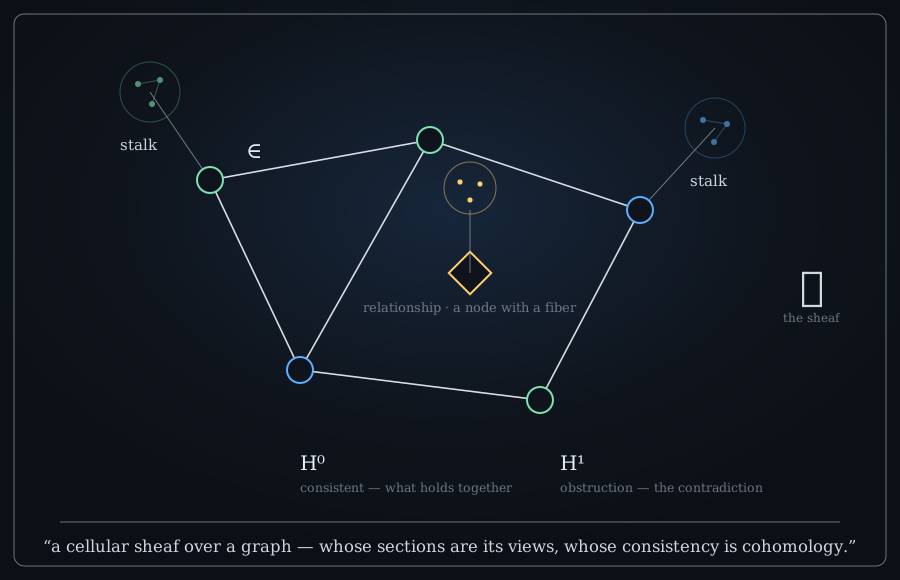
In graphs today, a relationship is at best a first-class citizen — a real object beside the nodes. That isn't far enough. A relationship isn't one citizen among equals; it is the First Citizen — and it doesn't just describe the world, it executes it.
What it is
The Intelligent Graph is the bridgework that carries the Collaboration Paradigm into implementation — the span from an idea about how intelligence collaborates to a substrate where it actually can.
Architecture gives you a place to move into — rooms, walls, a platform you're then stuck on. Bridgework is different. You don't sit inside a bridge; you connect to it, cross it, and extend it. TIG is a gateway, not a destination — relationship-first infrastructure your people, models, and agents connect to, traverse, and build onward from. Not a walled platform you're locked into; a span you cross.
A bridge is a relationship made traversable.
Begin with being
Relationships in graphs today are treated two ways. In the RDF stack, they're buried inside predicates. In Neo4j, they're promoted to first-class citizens: real objects, with identity and properties of their own.
Building from the original definition of ontology: nothing exists until the very concept of existence exists — something exists, OR it doesn't. You need the OR before the thing. To exist is to be an element of a set, and membership is that OR — in, or out. The distinction comes first, and a distinction is a relation.
So relationships are not just first-class citizens. They are the First Citizen.
Relationships realize entities. Realization is an action. A relationship isn't glue between two real things — it is what makes them real, and a thing that does. Reticulation, not reification.
Vector to the mathematics
Inference — derive what follows from what's said — is only the first floor. An operation's order is the order of structure it reaches over:
Model the graph as a cellular sheaf: data on every node and edge, with rules for how they must agree. A view becomes a section; consistency becomes cohomology — H⁰ is what holds together (knowledge), H¹ is the contradiction that can't (the obstruction). Grounding is driving H¹ toward zero.
The full consistency engine is the direction, not a shipped feature — we build toward it in the open. Read the math →
What this lets us build
Your LLM pipeline extracts a rich graph of concepts and how they relate — then your tools show almost none of it. A renderer only draws an edge when both endpoints are nodes, so the conceptual half — the ideas and how they connect — is never rendered, never traversed, never queried. The Intelligent Graph recovers that discarded layer as a non-destructive overlay, grounds it, and lets you act on it.
What it does
Read the source read-only; surface the relationships it extracted but couldn't display.
Type each raw relationship into a traversable graph — keeping the original string, so re-typing later is a single traversal, not a re-import.
Hitting a relationship can do something, not just return a row. The graph stops being a place you store knowledge and becomes one that executes.
Provenance is a property, not a supernode. Every step is reversible by construction. We attach to your graph; we never restructure it.
Why it's different
The register ladder
The point of bridgework is that it connects. Every concept has a word an executive can use, a word the graph implements, and a word the mathematics proves — and they map cleanly onto one another. The Intelligent Graph is the middle rung: the representational bridge between the everyday and the formal.
| Colloquial · Professional | Representational · TIG | Mathematical · Formal |
|---|---|---|
| Participant | Node / Entity | Object / Element |
| Steward | Curator / Governor | Observer / Constraint |
| Community | Sector / Scope | Group / Subspace |
| Collaboration Space | Graph Space | Manifold / Topology |
| Relationship | Edge / Contract | Relation / Morphism |
| Bridge | Traversable Edge | Mapping / Functor |
| Representative | View / Projection | Section |
| Fold | Identity Merge | Quotient / Equivalence |
| Reticulate | Structure Formation | Sheaf Gluing |
| Traversal | Path | Composition |
A bridge is a relationship made traversable; an edge, a relationship made representational; a morphism, a relationship made formal.
TIG + Solstone
The Intelligent Graph pairs with Solstone — Jeremie Miller's local-first memory platform — to turn a passive capture stream into a structured, queryable, annotatable graph. Sol captures and extracts; TIG recovers the discarded relationship layer, makes it traversable, and feeds curated interpretations back. Built for teams who want their own graph, on their own machine — not a hyperscale deployment.
Open core
The core will be open source (Apache 2.0) — we're building it in the open. A commercial layer adds the operational and agentic capabilities teams pay for.
Who's behind it
Built by Michael Bauer — a 35-year through-line from rule-based expert systems to a billion-node production graph. → michaelbauer.com
Featured at Neo4j NODES 2026, with Solstone: "The Graph Your Extractor Throws Away."